
Kim Reynolds and Paul Pate: Republicans Running Iowa
Despite endorsing Ron DeSantis in 2024, Iowa Governor Kim Reynolds has fully fallen in with the MAGA party line on election denial.
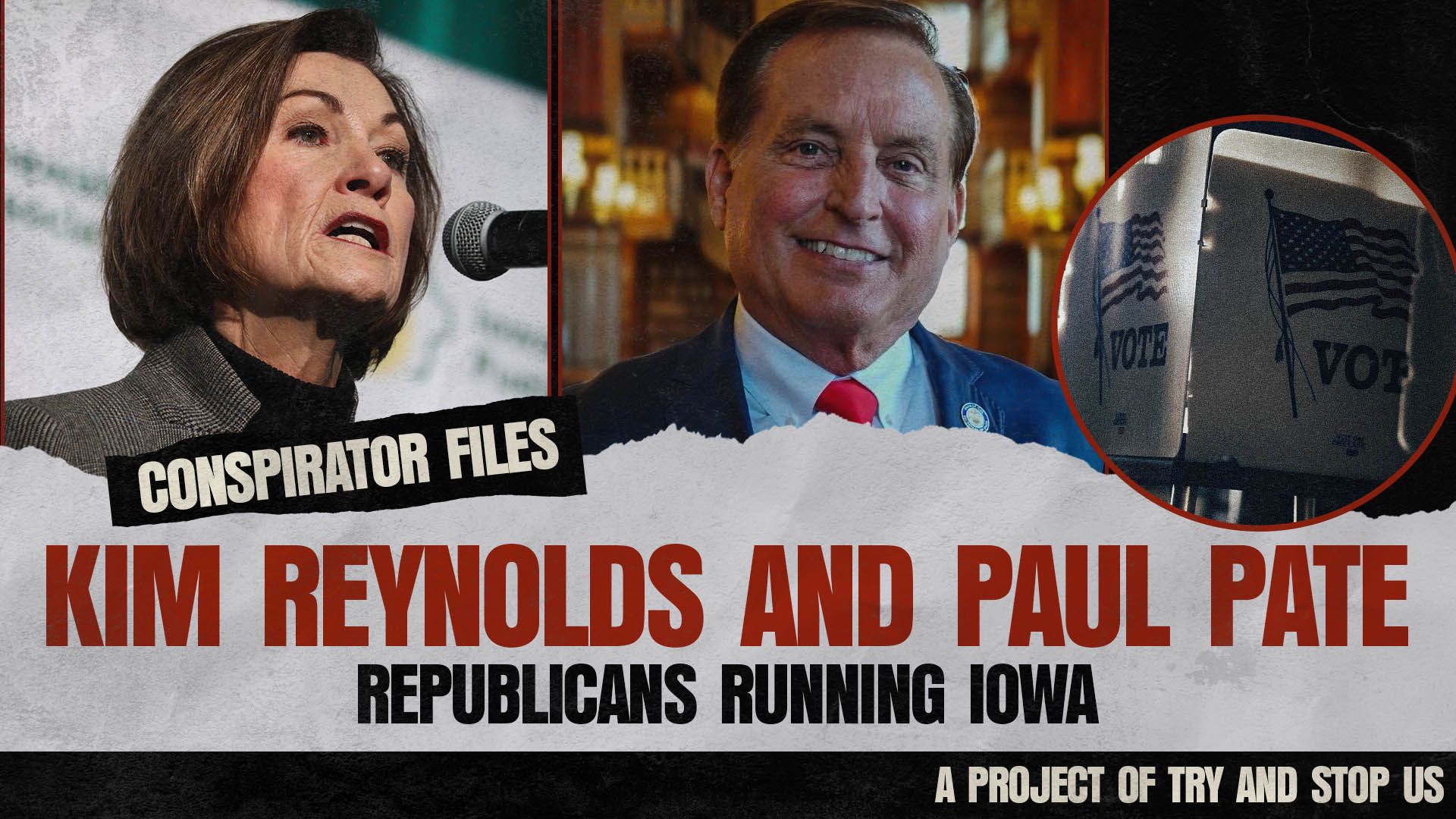
Despite endorsing Ron DeSantis in 2024, Iowa Governor Kim Reynolds has fully fallen in with the MAGA party line on election denial. Reynolds infamously blocked her Democratic Attorney General’s attempts to oppose the effort to overturn the 2020 election through the courts, and even said she would have joined the push herself. Iowa Secretary of State Paul Pate has also refrained from fully endorsing 2020 conspiracies, likely because that would reflect poorly on his record as an election administrator, but has nonetheless made use of those conspiracy theories to push voting restrictions. Just as Republicans become so unpopular that Iowa is seeing competitive elections, two of the state’s top Republicans are attacking fair elections based on conspiracies they admit to be false.
Worst moments:
- Reynolds denied her Attorney General’s request to defend four states Biden won in 2020 against an attempt by Republican AGs to throw out their results, and went as far as to say that she would have joined the lawsuit, if she had the authority to do so.
- Pate attempted to purge over 2,000 voters from the rolls while voting was already underway in 2024, claiming that they were “potential noncitizens.” He did so despite knowing that his list contained flawed data; the list in fact turned out to be at least 88% incorrect.
- Reynolds repeatedly signed election restrictions passed on the basis of unproven conspiracy theories. Based on Pate’s list that was nearly nine-tenths wrong, litigated and constrained by settlement, Reynolds signed a statute that gave the same office expanded authority to build such lists and flag voters as “unconfirmed.”
History of election denial
In December 2020, Reynolds denied Iowa Attorney General Tom Miller's request to join a multistate amicus brief supporting the defendants in the lawsuit by Texas AG Ken Paxton asking the Supreme Court to invalidate the electoral votes of Georgia, Michigan, Pennsylvania and Wisconsin. Miller, a Democrat, said he could not support a lawsuit seeking to “invalidate the votes of millions of Americans,” and said that had he been asked to join the Republican-led brief supporting Texas he would have declined, because he believed the 2020 elections were fairly and safely conducted by election officials of both parties. As she denied Miller’s request, Reynolds went even further, saying that if she held the authority she “would have requested that Iowa officially join in support of the lawsuit filed by the Texas Attorney General.”
Reynolds was able to wield this influence as a result of an arrangement she had constructed eighteen months earlier. In 2019, after the legislature passed a measure limiting the attorney general's authority to join out-of-state litigation, Reynolds item-vetoed it, but only after extracting an agreement from Miller. Her veto message states that Miller agreed that so long as he serves as attorney general, he will not prosecute any action or sign onto or author an amicus brief in the name of the State of Iowa in an out-of-state court without Reynolds’ consent.
When the legal effort Reynolds supported failed to overturn Trump’s loss and the election denial movement turned violent on January 6, Reynolds condemned the insurrection but failed to denounce the false claims of election fraud that instigated the mob. Weeks later, after Biden had been inaugurated, Reynolds was still claiming that “there are enough concerns about the integrity of the election process” that the election should be investigated further.
Serving on the Iowa Executive Council alongside Reynolds is Secretary of State Paul Pate, the official responsible for overseeing Iowa’s elections. As an elections administrator, conspiracy theories about “stolen elections” put Pate in an awkward position: entertaining the conspiracists would amount to admitting that he had failed at his job. Pate has threaded the needle by consistently defending the accuracy of Iowa’s results while still using conspiratorial rhetoric to justify taking steps to interfere with fair elections.
Despite making clear that Iowa elections are secure, Pate has notably refused to disavow Republican election deniers, and even made an attempt at disenfranchising thousands of Iowans based on conspiracy theories about noncitizen voting. With early voting already underway in the 2024 election, Pate directed county auditors to challenge the ballots of 2,176 registered voters he identified as “potential noncitizens.” Those voters were to cast provisional ballots that would count only if they later proved citizenship. Pate issued the requests despite admitting that the data was “flawed” and that most people on the list were likely citizens. A lawsuit against Pate by voting rights groups resulted in a settlement prohibiting the future use of the list. As part of the settlement, Pate agreed that at least 88% of the people on the list were in fact citizens, and the ACLU of Iowa noted that “citizenship status of the remaining 12 percent has not been proven.”
Influence over election administration
As Governor, Reynolds has signed two pieces of major legislation that have made it more difficult for Iowans to vote, both times in response to baseless election conspiracy theories promoted by Iowa Republicans:
- SF 413 (2021) The first major post-2020 voting restriction enacted anywhere in the country, this major overhaul passed along party lines after just two weeks of consideration. It cut early voting from 29 days to 20, closed polls an hour earlier at 8 p.m., tightened absentee request and return windows, limited drop boxes, restricted who may return another voter's ballot, barred counting ballots received after Election Day even if timely mailed, moved voters to inactive status after a single missed election, and added penalties for election misconduct aimed at county auditors. Republican supporters of the bill claimed it was necessary to prevent voter fraud, and one GOP Senator revealed that “most of us in [...] the Republican caucus believe the election was stolen.”
- HF 954 (2025) Another set of major changes to Iowa election law, this round was triggered by the Iowa Secretary of State’s false claims of widespread noncitizen voting. In the days before the 2024 general election, Secretary of State Paul Pate issued guidance to county auditors challenging roughly 2,000 ballots cast by voters identified as “potential noncitizens.” The ACLU sued, and when a settlement was later reached that prohibited Pate from using the list, the ACLU's legal director noted the figures showed at least 88% of the people on that list were in fact U.S. citizens. Nonetheless, Reynolds signed the bill giving Pate the authority to contract with federal agencies, state agencies, and private entities for voter roll “verification and maintenance.” The legislation also creates an “unconfirmed” registration status for voters whose citizenship the state cannot verify, triggered when officials receive information from a “reliable source” that a person is not qualified, and bans local governments statewide from adopting ranked-choice voting.
Meanwhile, Pate has cooperated fully with federal efforts to get involved in state-administered elections. Pate turned over Iowa's voter registration list, including driver's license and partial Social Security numbers, to Trump's Justice Department. Ryan Peterman, Pate’s opponent in his re-election race, called it “indefensible” and noted that “the DOJ has had every single lawsuit seeking this very data dismissed in court so far.” Had Pate chosen to fight, instead of falling in line with the group of Republican-led states that surrendered their records to the DOJ, he likely would have won, as have all 16 states that took the administration to court. Instead, Pate provided the Trump administration with records that recent revelations show have been used for immigration enforcement and weaponizing the federal government against voter registration groups.
Don’t read the next headline alone.
Get rapid-response alerts and the real story behind the headlines, straight to your inbox.
Get InvolvedKeep Reading

Rick Jackson and Mike Collins: Election Deniers for Georgia
Rick Jackson and Mike Collins are, respectively, the Republican nominees for Governor and Senator in this year’s election in Georgia.
Read More
Heather Honey: Grassroots Election Denier to Federal Investigator
Heather Honey is a Pennsylvania “election researcher” who spent the years after 2020 producing data analyses purporting to show fraud.
Read More
Georgia State Election Board: The MAGA Majority
The current incarnation of the Georgia State Election Board, the body which oversees Georgia’s election administration, has been heavily shaped by the election denial movement.
Read More