
Bill Huizenga and Tom Barrett: Election Deniers for Congress
Bill Huizenga and Tom Barrett are election deniers and the Republican nominees for two of Michigan’s seats in the House of Representatives.
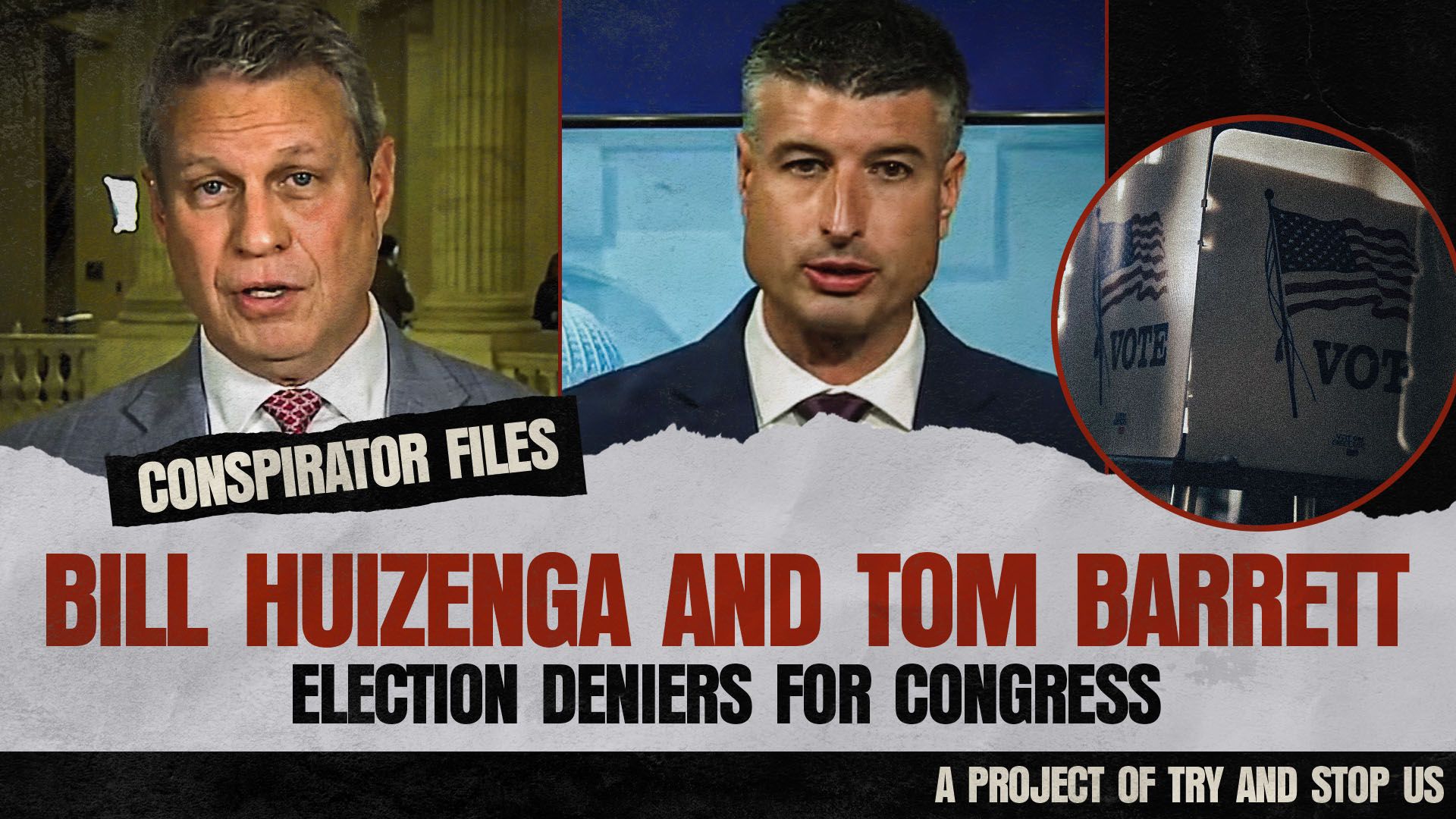
Bill Huizenga and Tom Barrett are election deniers and the Republican nominees for two of Michigan’s seats in the House of Representatives. Both are incumbents: Huizenga has held a seat since 2011 while Barrett is serving his first term in Congress after spending eight years in the Michigan legislature. Running in two of this year’s most competitive House districts, Huizenga and Barrett represent some of democracy supporters’ biggest opportunities to refuse the election denial caucus more seats in Congress.
Worst moments:
- Huizenga joined an effort by Congressional Republicans in support of a Texas lawsuit to throw out Michigan voters’ choice to kick Trump out of office in 2020, and instead hand the decision to the Republican-controlled legislature, despite admitting nearly a month later that he had seen no evidence of fraud.
- Barrett was personally thanked by Donald Trump for his spreading of election conspiracy theories in November 2020, and joined a letter asking Congress to take unprecedented measures to investigate those unfounded claims.
- Barrett has since refused to commit to acknowledging Trump’s 2020 loss, nor has he said definitively that he would have voted to certify Michigan’s votes for Biden if he had held office at the time.
History of election denial
In December 2020, Huizenga and three other Michigan representatives signed a brief from over 100 Congressional Republicans supporting Texas’ lawsuit against Wisconsin, Michigan, Georgia and Pennsylvania. The brief argued that irregularities in those four swing states, all of which had been won by Biden, “cast doubt upon its outcome.” Huizenga asked the courts to throw out the choices made by his own state’s voters, but conspicuously did not question his own victory despite having been reelected on the very same ballots.
Huizenga attempted to defend his advocacy for reversing Michigan voters’ decision by arguing that the lawsuit sought to put the decision in the hands of the state legislature, despite the fact that Michigan election law provides no role for state legislators in determining the allocation of electoral votes. Even setting aside the illegality of the proposal, Huizenga’s claims are hardly a defense as the Michigan State Legislature was then controlled by Republican majorities, many of whom signaled their willingness to overturn the will of the voters. Huizenga also claimed that Michigan Secretary of State Jocelyn Benson acted unlawfully when she mailed out absentee ballot applications, despite a Michigan court having ruled the mailing legal months before. The Supreme Court rejected the lawsuit the next day.
In a move that reveals Huizenga knew his allegations to be false, he declined to object to Michigan’s electors and did not join the Arizona and Pennsylvania objections on January 6, saying beforehand that he had seen no evidence of “system-wide, systematic vote fraud.” If Huizenga still had not seen evidence of fraud nearly a month later, what could possibly have motivated his decision to join the brief other than an unwillingness to accept Michigan’s rejection of Donald Trump? Huizenga went on to reject accountability for the January 6 insurrection, voting against impeaching Trump for inciting the riot and voting against two attempts to establish Congressional committees to investigate the events.
Meanwhile, Barrett was working to overturn Michigan’s election results as one of the very state legislators that Huizenga sought to empower. Shortly after Biden’s victory, Barrett “posted on social media about alleged ballot irregularities” and “received a personal thank-you note” from Trump for calling for a pre-certification audit, a move not allowed by Michigan law. Barrett then joined a group of Michigan Republicans who met with Trump in the White House in November 2020 to discuss their options. While some GOP representatives left the meeting pledging to uphold the law, Barrett kept pushing for ways to hand Trump the election.
Then, days before Congress met to certify Biden’s victory, Barrett and ten other Republican state senators signed a letter asking Congress and federal law enforcement to investigate “credible allegations of misconduct” in the 2020 election. Michigan Advance noted there were no such credible allegations, and the Argus-Press reported that the senators’ letter repeated numerous unfounded and disproven fraud claims. A version that circulated publicly asked Congress to “temporarily delay certification in the name of national unity.” Its author, Sen. John Bizon, said that version was an early draft sent out by mistake, and Barrett likewise claimed that he did not seek a delay, but the accidental release demonstrates that the GOP legislators were actively considering unprecedented measures to keep their hold on power.
Barrett has since dodged acknowledgement of Trump’s 2020 loss. In 2022, Barrett refused to answer a question from Detroit Free Press about whether he would have certified the 2020 results, calling it “an unknowable thing,” and pointing to absentee ballots he suggested were cast by ineligible voters. By then, Michigan’s Republican-led Senate Oversight Committee had already concluded the 2020 election produced no significant evidence of fraud. At a 2022 debate with Elissa Slotkin, Barrett could only say that he “probably” would have certified the 2020 results, deflected from a direct question about whether Biden won Michigan by criticizing Secretary of State Jocelyn Benson instead of answering, and said he would certify only after a “debate.”
Influence over elections
Huizenga and Barrett have repeatedly shown their alignment with national Republican leaders who are pushing voting restrictions rooted in election denial. In July 2025 Trump personally urged Huizenga to seek reelection, citing his importance to Republicans as vice chair of a major committee, and promised him a “complete and total endorsement,” telling his social media followers that Huizenga “will never let us down.” Trump has also repeatedly endorsed Barrett, and demonstrated an understanding of the importance of Barrett’s seat to maintaining an anti-election Republican majority by maintaining his support even after Barrett attempted to distance himself. Barrett and Huizenga have both received personal campaign support from GOP House Speaker Mike Johnson.
Republican party leaders support Barrett and Huizenga because they know them to be reliable votes for their election-restricting legislative agenda. Both men are strong supporters of the SAVE Act, a restrictive voting bill that could disenfranchise millions of eligible American voters, disproportionately affecting women. Barrett and Huizenga both voted for the SAVE Act and an even more restrictive version of the bill called the SAVE America Act, and touted their votes in press releases.
Most concerningly, Huizenga and Barrett could use their House seats to vote against certification of 2028 election results, if they are still in Congress. Though a law passed in 2022 was intended to limit the grounds on which members of Congress can object to states’ electoral votes, Huizenga’s support for throwing out legitimate electoral votes in 2020 and Barrett’s repeated suggestions that he would have voted against certification had he been a member at the time indicate that both men could support spurious and illegitimate objections to a future Democratic presidential election victory.
Don’t read the next headline alone.
Get rapid-response alerts and the real story behind the headlines, straight to your inbox.
Get InvolvedKeep Reading
John James and Mike Rogers: Election Deniers for Michigan
John James and Mike Rogers are, respectively, the Republican nominees for Governor and Senator in this year’s election in Michigan.
Read More
Ashley Hinson: Republican for Senate
Ashley Hinson’s record epitomizes the rhetoric of a soft denialist.
Read More
Kim Reynolds and Paul Pate: Republicans Running Iowa
Despite endorsing Ron DeSantis in 2024, Iowa Governor Kim Reynolds has fully fallen in with the MAGA party line on election denial.
Read More